The Foundation for a Better Life
The Flop that Revolutionized a Sport.
Young Dick Fosbury began the high jump like every other jumper, throwing one leg over, then the other. After a mediocre finish in a track meet, he looked at the physics of jumping. Could it be that they were all doing it wrong?
By The Foundation for a Better Life
Place a pole horizontally between two upright pillars and see who can jump the highest. A simple competition that originated in Scotland to accompany the tossing of nine-foot logs and fifty-pound boulders. Then, in 1968, a gangly kid from Medford, Oregon, changed everything.
The sport of high jumping didn’t evolve much for its first 150 years. Athletes approached the bar straight on and scissor-kicked their way over. This was modified into the western roll, where one leg was thrown over and the body rolled over the bar, always facing the landing, which was a pile of sawdust.
Then, two things happened almost simultaneously. The messy sawdust pile was replaced with a deep foam mattress, and Dick Fosbury struggled with his own coordination to master the current jumping techniques.
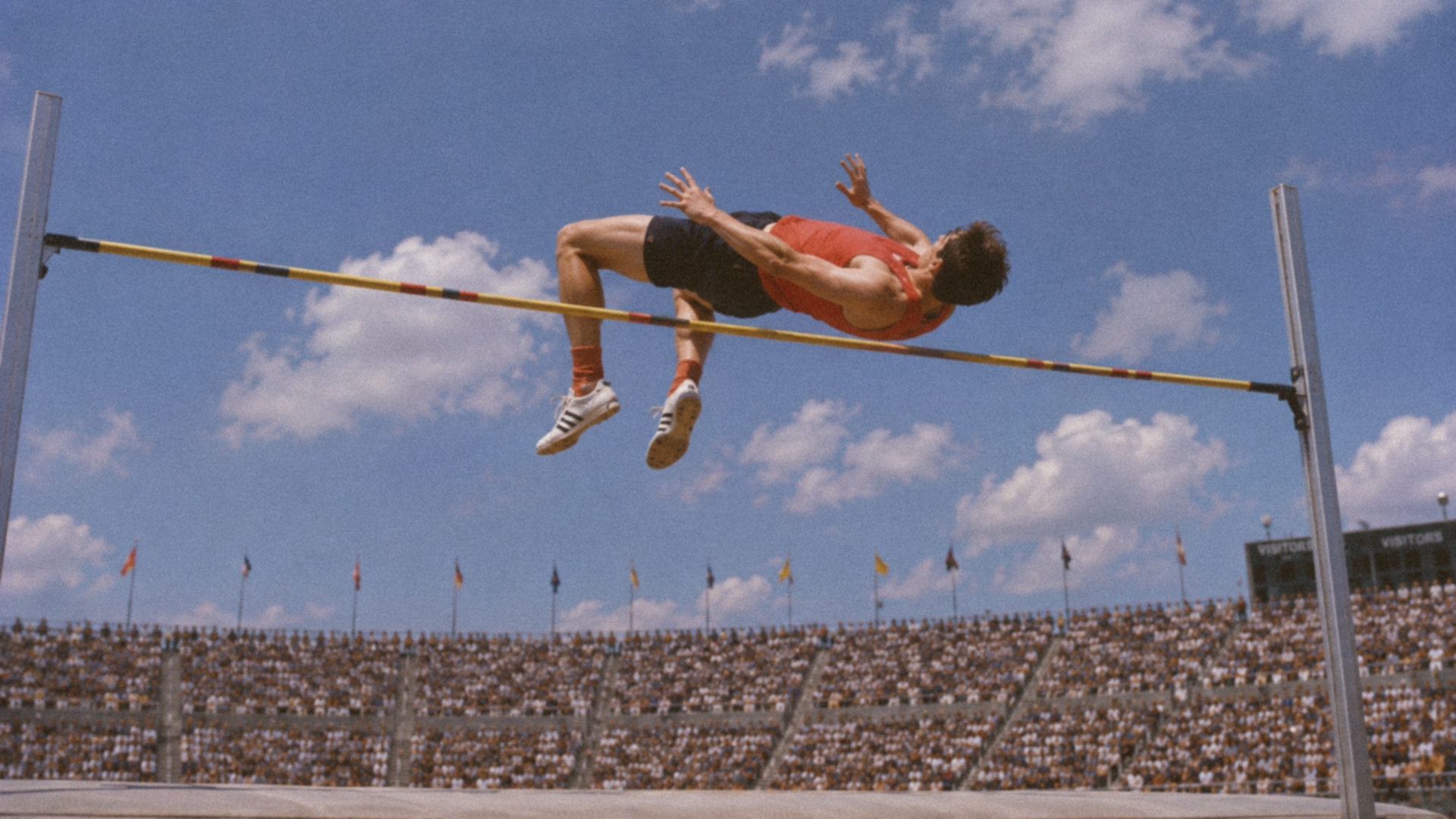
Refusing to quit, Fosbury began experimenting with better ways to clear the bar, ways that took advantage of his height, his build and physics. He changed the run-up, curving his approach to leverage centrifugal force. Then he launched from his outside foot and heaved his body over the bar backward, curving gracefully over the bar and landing squarely on his shoulders. By curving his run-up and laying out horizontally, Fosbury lowered his center of gravity relative to the bar as he crossed it, allowing him to clear significantly greater heights with less vertical explosive power than traditional jumpers required.
It didn’t go well. Critics dismissed it as awkward and ungainly. Coaches refused to teach it, and the U.S. Olympic coach openly criticized the unorthodox technique, claiming the resulting injuries would wipe out a generation of jumpers.
Undaunted, Fosbury continued to train in obscurity – that is, until the 1968 Olympics.
Overnight, Fosbury jumped from obscurity to international sensation. That year, 600 million people tuned into the Olympics, and a gangly, affable 21-year-old high jumper from a small town in Oregon was the athlete everyone was talking about. The crowd at the arena audibly gasped every time Fosbury launched himself over the bar backward. They sat on the edges of their seats with each run-up.
Jump after jump, the bar was raised higher and fewer competitors participated. Finally, the field was down to three athletes: fellow American Ed Caruthers, Valentin Gavrilov of the Soviet Union and Fosbury.
Gavrilov went out first, leaving the two Americans to compete for the gold. The bar was set at 2.24 meters (7 feet 4.25 inches), a new Olympic record if one of them could clear it. Both missed on the first attempt and the second. On the final try, Caruthers brushed the bar, leaving the two at a tie if Fosbury also failed his last attempt. Rocking back and forth on the take-off, leaping into his first stride, bending his approach to recruit centrifugal force, planting his outside foot for launch, arching his neck and shoulders over the bar, followed by a graceful layout, back curling, and that last heel kick. Did the bar move? No. Cleared.
Fosbury had just revolutionized a sport. Within a decade, all other techniques would vanish. The Fosbury Flop would be responsible for 18 world records between women’s and men’s competitions. The current men’s record is a staggering 8 feet, ¼ inch, held by Javier Sotomayor from Cuba since 1993.
It all started when a gangly kid from Medford, Oregon, decided to keep trying, to keep jumping, to push himself into territory that had never been done before.
Soar Higher… PassItOn.com®
Copyright ©2026 The Foundation for a Better Life. All rights reserved. Available under a Creative Commons Attribution NonCommercial-NoDerivatives 4.0 License (international): https://creativecommons.org/licenses/by-nc-nd/4.0/

The Foundation for a Better Life, a 501(c)(3) non-profit organization, gives your newspaper permission to publish these stories in print and electronic media (excluding audio and video), provided the stories are published in their entirety, without modification and including the copyright notice. For any modification, permission must first be obtained from the Foundation by emailing media-relations@passiton.com. Thank you.
We add new stories each month. If you'd like to be notified when we publish new stories, enter your information below.