The Foundation for a Better Life
A History of Humanitarianism.
250 years of prosperity in America has brought about the world’s most charitable philanthropists. Andrew Carnegie set the pace.
By The Foundation for a Better Life
In the mid 1800s, a boy from Scotland arrived in America, his parents seeking a better life. Andrew Carnegie had nothing but a pocket full of dreams and a love for heroes like Robert Bruce and William Wallace. But it was the American story of Horatio Alger he became most attached to. The rags to riches tale inspired ingenuity and rewarded it with wealth and opportunity. But his arrival in Pennsylvania was anything but charmed. His parents struggled to make ends meet and Andrew went to work as a bobbin boy, his nimble fingers changing bobbins in a cotton mill 12 hours a day, 6 days a week. He was 12 years old. He moved on to become a telegraph messenger boy and later, operator. On his rare off time, Andrew Carnegie could be seen with his nose in a book. He learned whatever he could, pestered his superiors for knowledge, and worked hard. He also invested. His philosophy of living frugally and accumulating wealth would guide him his entire working career.
Carnegie’s curious mind led him to innovations that benefitted his employers, and his management skills and tough negotiating style moved him up the ranks in management until he was ready to venture out on his own. His investment in oil paid off well and with those profits he established a steel company. As his wealth grew, Andrew Carnegie was determined to create opportunities for others, beginning with libraries. He loved reading and bemoaned the lack of access to good books. When he sold his steel business for the equivalent of $13 billion in today’s dollars at age 65, he devoted the rest of his life to giving away his fortune. In his essay The Gospel of Wealth, Carnegie outline the ethics of prosperity and the moral obligation of those with money. His hardscrabble upbringing and his innate humanitarianism had created in him a desire to set forth not only a foundation to support worthy causes, but also a philosophy of giving. He believed it was the obligation of wealthy individuals to give away surplus wealth for lasting social benefits such as libraries, schools and cultural institutions. He preached against extravagance and self-indulgence, arguing that wealth should not encourage laziness. He viewed wealth as a tool to reduce social inequality, and he was a lifelong supporter of education.
The young, wide-eyed Scottish boy who saw opportunity to do more and become more, even when his family suffered privations, had a vision for a better world. He devoted the last twenty years of his life building it through strategic philanthropy and became a model for future philanthropists. He built more than 2000 libraries, endowed universities, scholarships, teachers’ pensions, and institutions to promote arts, literature and music. He funded the Peace Palace in the Hague, Netherlands, that is now the home of the International Court of Justice; a poetic reminder that peace and justice are only possible when a society provides opportunity for all its citizens.
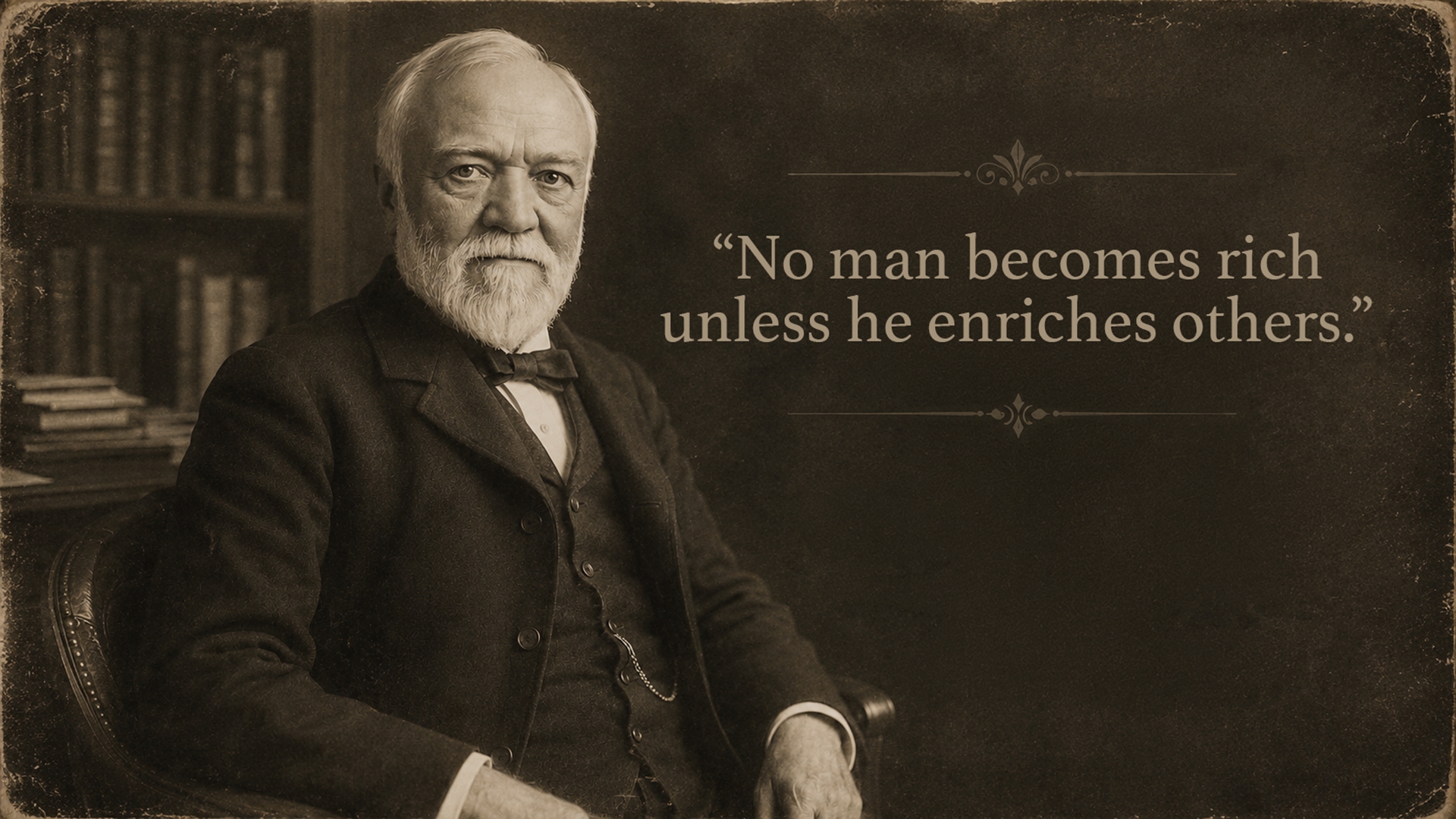
By the time of his death, Carnegie had given away 90 percent of his fortune. He accepted that he could not give away all his wealth in his lifetime and so set up a corporation to continue giving after he was gone. A legacy that has lasted over 100 years. “No man becomes rich unless he enriches others,” Carnegie wrote, but more importantly, lived.
Inspire Others… PassItOn.com®
Copyright ©2026 The Foundation for a Better Life. All rights reserved. Available under a Creative Commons Attribution NonCommercial-NoDerivatives 4.0 License (international): https://creativecommons.org/licenses/by-nc-nd/4.0/

The Foundation for a Better Life, a 501(c)(3) non-profit organization, gives your newspaper permission to publish these stories in print and electronic media (excluding audio and video), provided the stories are published in their entirety, without modification and including the copyright notice. For any modification, permission must first be obtained from the Foundation by emailing media-relations@passiton.com. Thank you.
We add new stories each month. If you'd like to be notified when we publish new stories, enter your information below.